Calculation with a jinja type
Objectives
In this section we will learn how to create new ways of calculation.
Up to now, our only way of dynamically (that is, during the runtime) calculating a value is to point on another variable’s value. But this is not the only way.
Todo
on peut aussi faire un exercice de ce genre pour la propriété mandatory
Another jinja calculation type sample
We can now hide or disable some variables or families with other techniques than pointing on a variable’s value.
Let’s reason upon the proxy’s manual configuration we discussed before.
We have the dict/02-proxy_manual.yml structure file:
structfile/02-proxy_manual.yml file ---
version: '1.1'
manual:
description: Manual proxy configuration
type: family
disabled:
type: jinja
jinja: |
{% if rougail.proxy.proxy_mode != 'Manual proxy configuration' %}
the proxy mode is not manual
{% endif %}
Question
question: OK then. What happens when you select the “Manual proxy configuration”?
Here if the user selects the “Manual proxy configuration” proxy mode,
the the manual family will be disabled. This is what the jinja code says.
Let’s explain it more precisely.
Note
The “the proxy mode is not manual” output is be used in the log outputs for example while
Why Jinja?
What about this Jinja type?
If the Jinja template returns some text, then the family will be disabled. Otherwise it is accessible.
Deactivating a family means that we will not be able to access it as well as the variables or families included in this family.
Note
If the Jinja template does not return any text, the variable will be enabled. Here we are using the Jinja condition statement.
What can be calculated?
We have seen that the disabled or hidden properties could be calculated.
The default values can be calculated too.
Todo
montrer un exemple de valeur par défaut calculées (type jinja)
Todo
montrer aussi ici des exemples de calculs de valeurs variables, ce qui est un des usages principaux de jinja
Using jinja in a dynamic family declaration
Let’s come back to the previous section’s dynamic family example.
In a dynamic family, as seen before, you have the possibility to name your identifier. In the classic declaration, the identifier’s variable is named “identifier” by default. Sounds logical:
"{{ identifier }}_proxy":
  description: "{{ identifier }} Proxy"
  dynamic:
    - HTTPS
    - SOCKS
Here the identifer’s variable takes the value of the dynamic family parameter.
Using a jinja calculation with a parameter
We have the possibility to use a given variable variable inside a jinja calculation:
%YAML 1.2
---
version: 1.1

manual:

  use_for_https: true  # Also use this proxy for HTTPS

  https_proxy:
    description: HTTPS Proxy
    hidden:
      variable: _.use_for_https

    address:
      description: HTTPS address
      default:
        variable: __.http_proxy.address

    port:
      description: HTTPS Port
      default:
        variable: __.http_proxy.port
...
This can be done by defining a my_identifier variable.
This jinja variable comes from the params parameter of the hidden property.
params:
  my_identifier:
    type: identifier
Here the hidden property’s value is defined by a jinja calculation.
In this jinja calculation we have a my_identifier jinja variable.
hidden:
  jinja: |
    {% if my_identifier == 'HTTPS' and manual.use_for_https %}
    HTTPS is same has HTTP
    {% endif %}
  params:
    my_identifier:
      type: identifier
  description: |
    in HTTPS case if "manual.use_for_https" is set to True
The when and when_not parameter notation
Todo
ça devrait être sur une autre page. déplacer cela ailleurs
Handling the SOCKS version
Now we need to handle the SOCKS version as show in the firefox configuration screenshot:
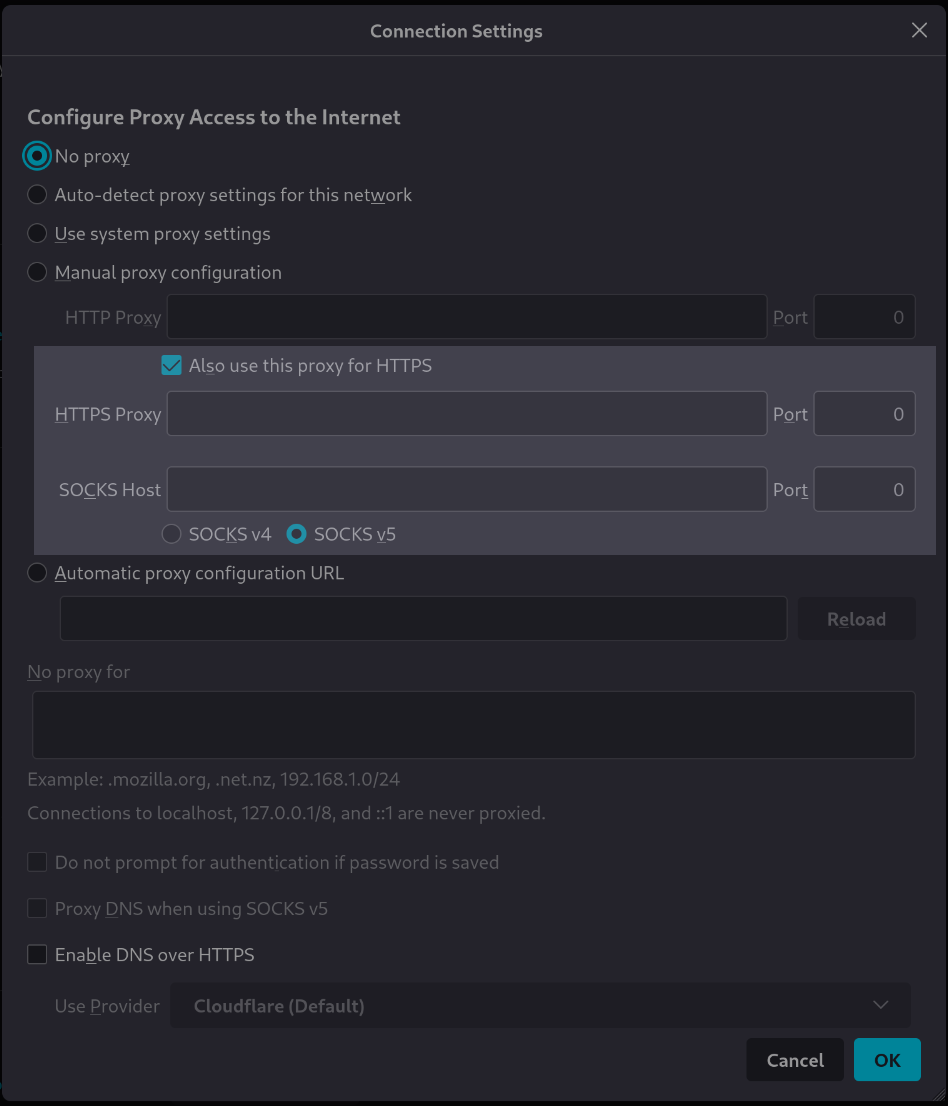
We’ll just add a choice variable with a default value and a disabled property:
version:
  description: SOCKS host version used by proxy
  choices:
    - v4
    - v5
  default: v5
  disabled:
    type: identifier
    when: 'HTTPS'
There is still something new about this YAML, though. It is the when parameter
of the disabled property. You have two possible notations: when or when_not.
These two notations are just a short hand of what we could express in jinja as
this code:
{% if identifier == 'HTTPS' %}
when the identifer equals 'HTTPS' then the SOCKS version is disabled
{% endif %}
And the when_not parameter is just the logical opposite.
Here is the final version of our YAML dynamic family:
%YAML 1.2
---
version: 1.1

manual:

  use_for_https: true  # Also use this proxy for HTTPS

  https_proxy:
    description: HTTPS Proxy
    hidden:
      variable: _.use_for_https

    address:
      description: HTTPS address
      default:
        variable: __.http_proxy.address

    port:
      description: HTTPS Port
      default:
        variable: __.http_proxy.port
...
Key points
keywords
calculation with a jinja type calculation
calculation with a
whenorwhen_notparameterdefining a jinja internal variable in a jinja calculation
progress
Here we have come to the possibility of making any kind of calculations based on the state of the configuration. This is an important feature to manage the stateful aspect of a configuration.